An artist trains a model on their own music, on their own computer, and owns
it. Fans pay to use it. Every piece it makes is recorded and marked, and the promises are written into the
company's constitution. Here is each part, and the pages that go deeper.
The model belongs to the artist.
The two tools
One
The Workshop
Free to use, and it runs on the artist's own computer. They train a model on their own catalogue, and nothing leaves the machine unless they choose to send it. The model belongs to them, with no platform claim and no exclusivity.
Working prototype. The pilot opens on 1 December; public release in 2027.
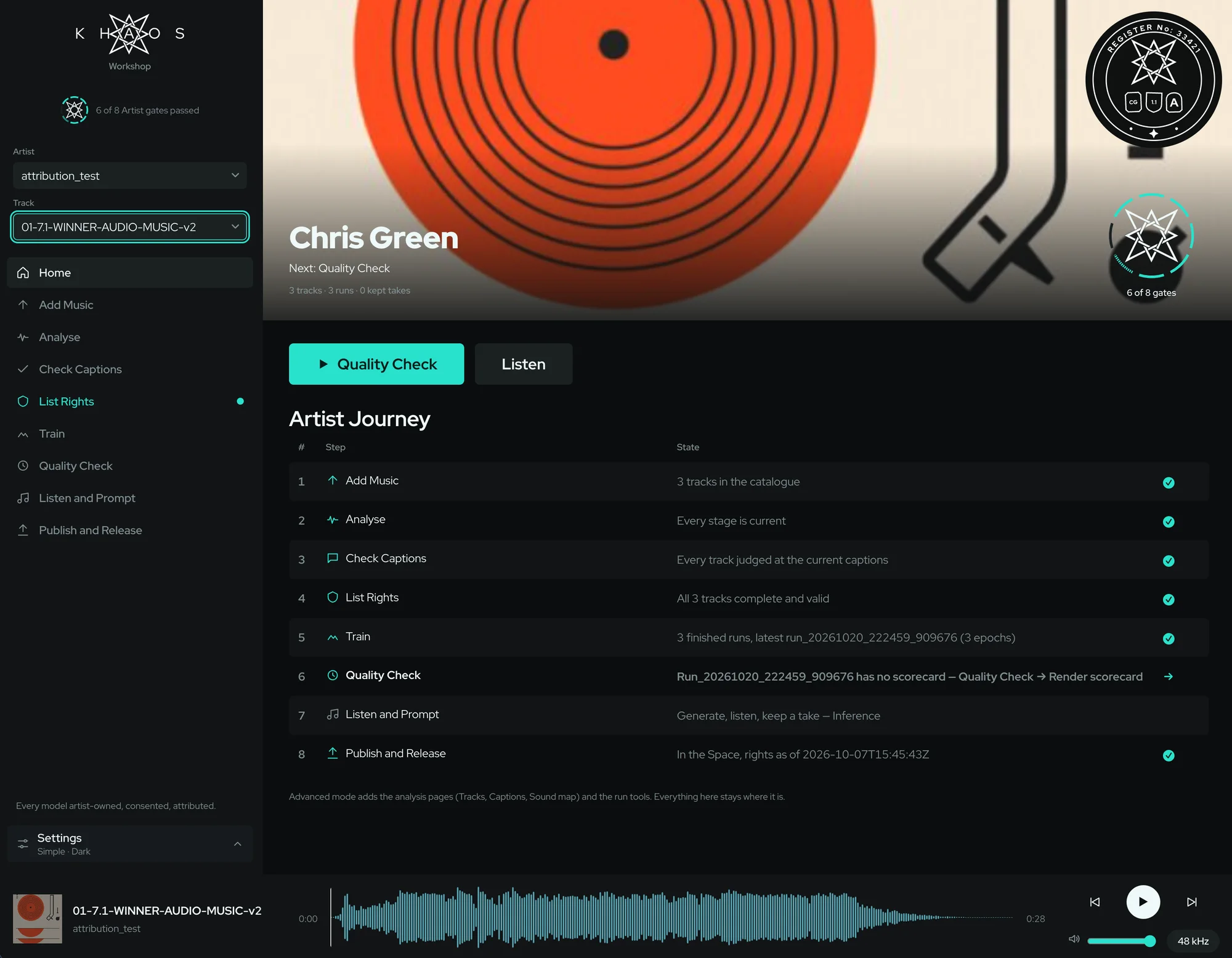
The Workshop: one artist's journey from adding music to publishing, with what is done and what comes next.Two
The Listening Space
A fan goes to one artist's room and asks for new music in that artist's sound, and hears what that artist's model makes for them. The artist sets the price and keeps the relationship with the fan.
In proof of concept. Opens in 2027, when fans can pay to use an artist's model.
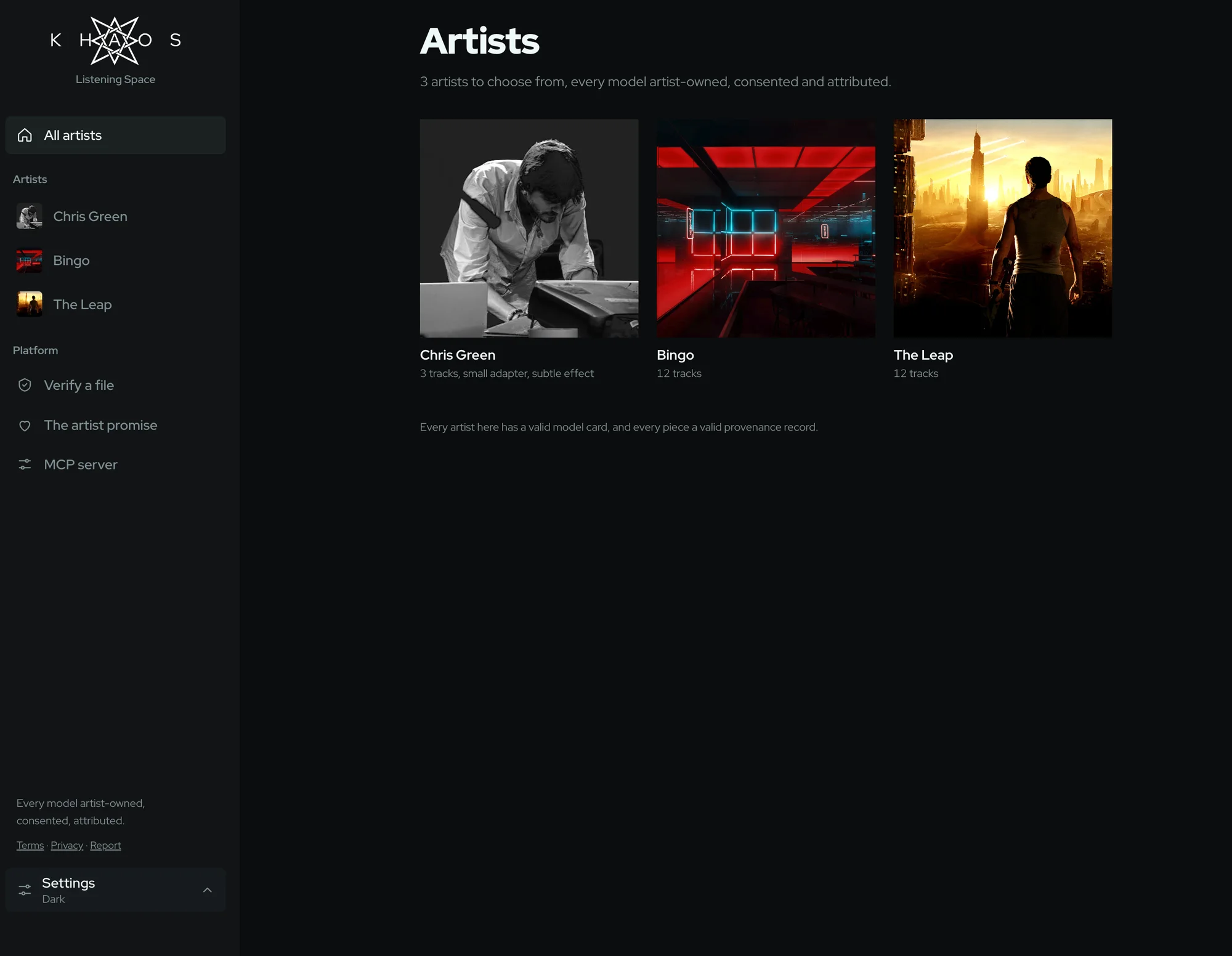
The Listening Space: one room per artist.
Six steps, in order
Cleared
A rights map
Before anything is trained, every track is checked: who holds the master, the song, the performances. Fingerprint, ISRC and agreement checks flag anything with an uncleared co-writer, sample or session player.
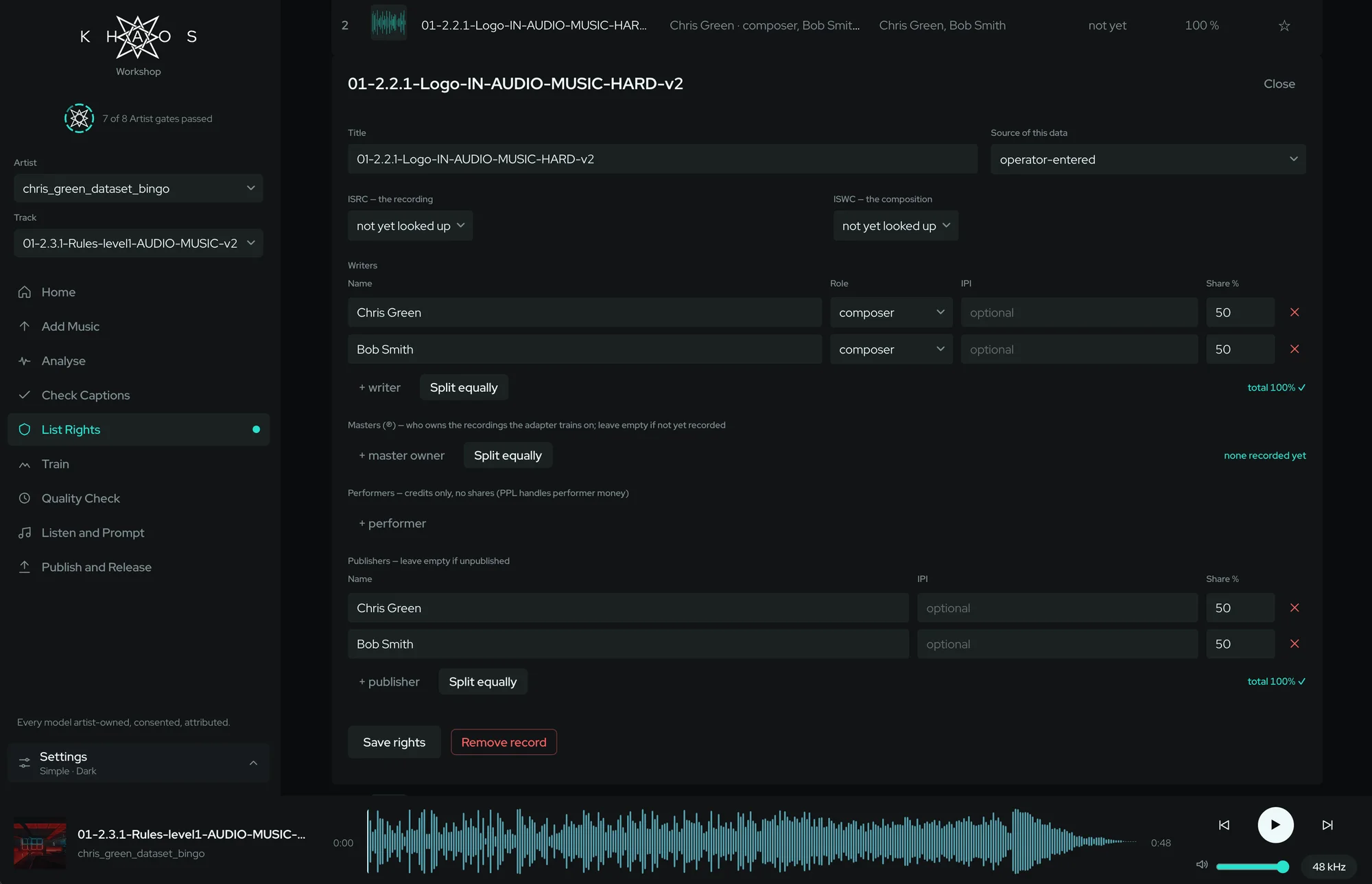
The rights map in the Workshop: who wrote and published each track, and their shares. Bob Smith is test data.
Consented
Written consent
Each writer and performer is asked in writing, for this purpose only, with the right to withdraw. No default opt-ins. Those who say no are left out and lose nothing. A voice is never trained without separate consent.
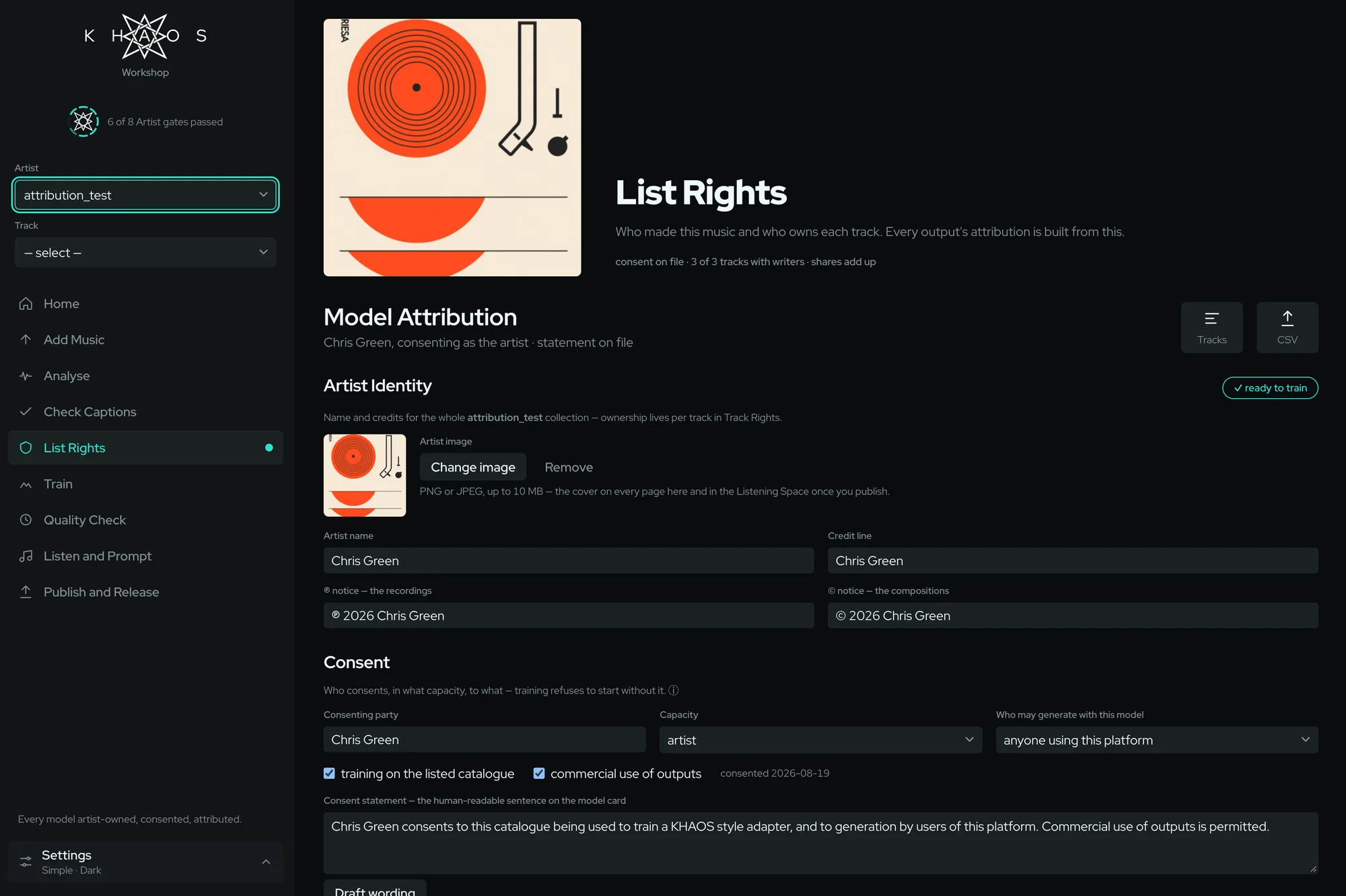
The consent record in the Workshop. Training does not start without it.
Trained
Training on cleared tracks only
The model trains on the artist's own machine. The catalogue goes to no third-party AI company. A usable model needs as few as eight tracks; twenty or more is better.
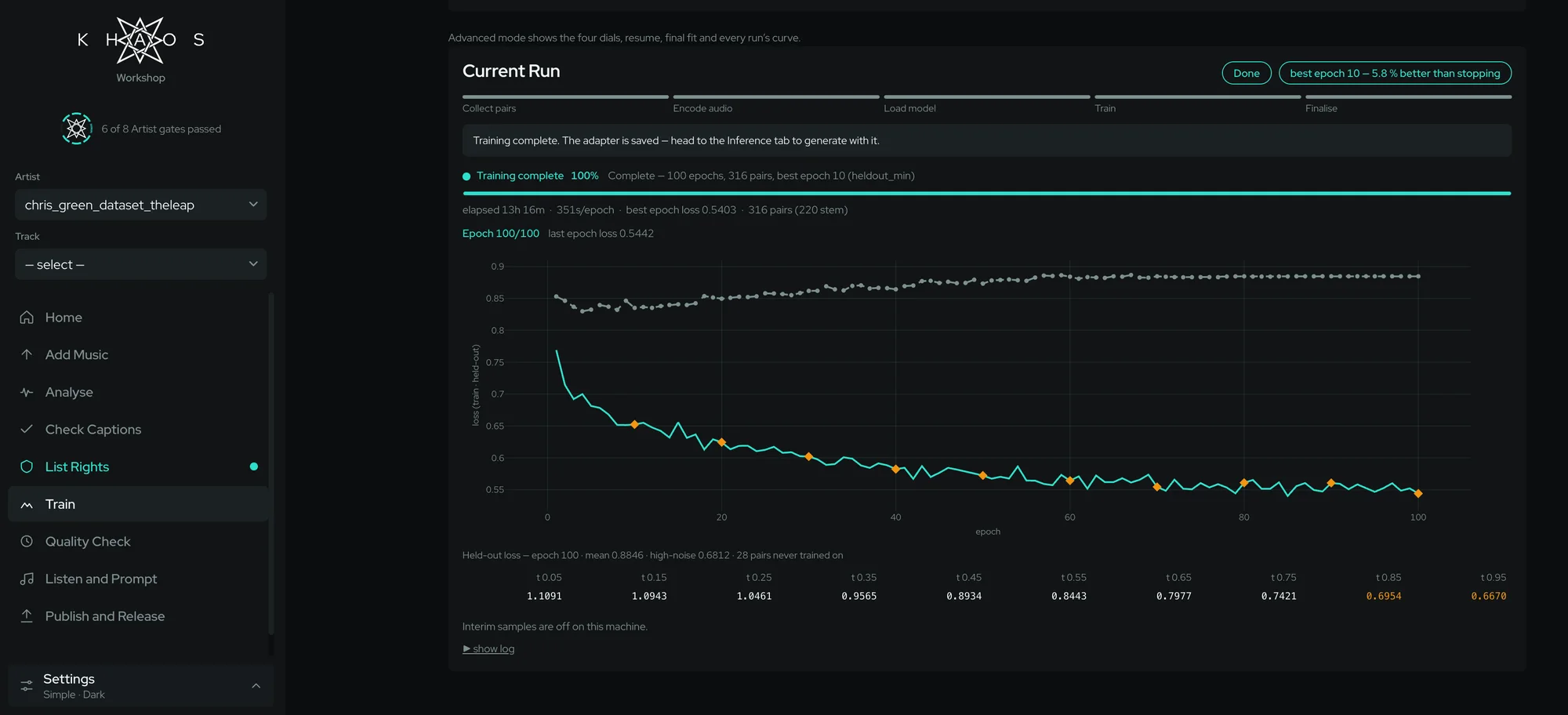
A training run in the Workshop, on the artist's own machine: 100 epochs over 13 hours, with the best epoch kept.
Tested
Testing before release
The model is checked for memorisation. A model that reproduces a training track is not released.
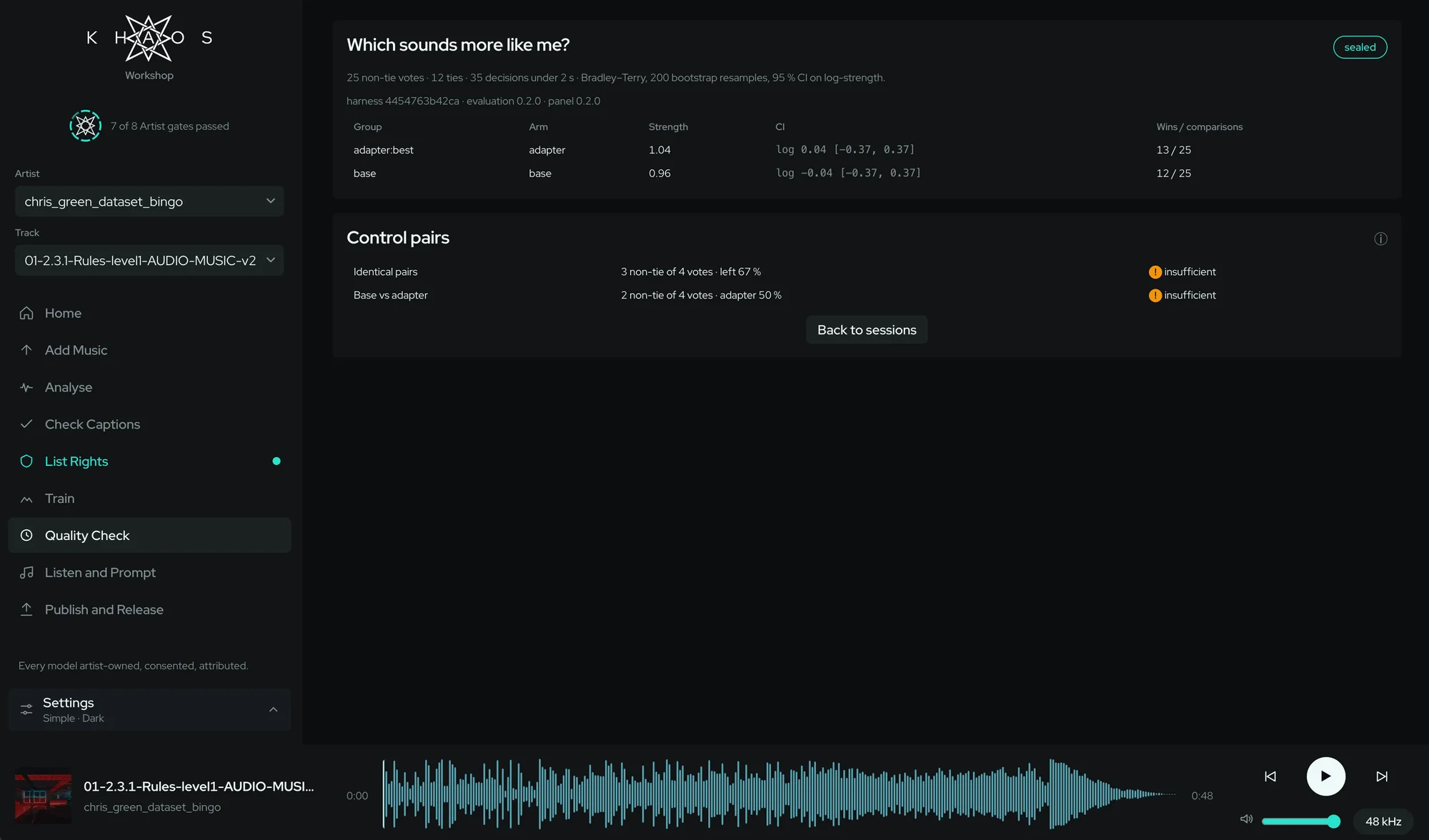
A sealed blind listening session in Quality Check: which of two sounds more like the artist, with control pairs that say whether the panel can be trusted.
Listened
A room
The model sits in the artist's room in the Listening Space. The artist sets what fans can ask for, who gets in and what a session costs. By default nothing can be downloaded or released.
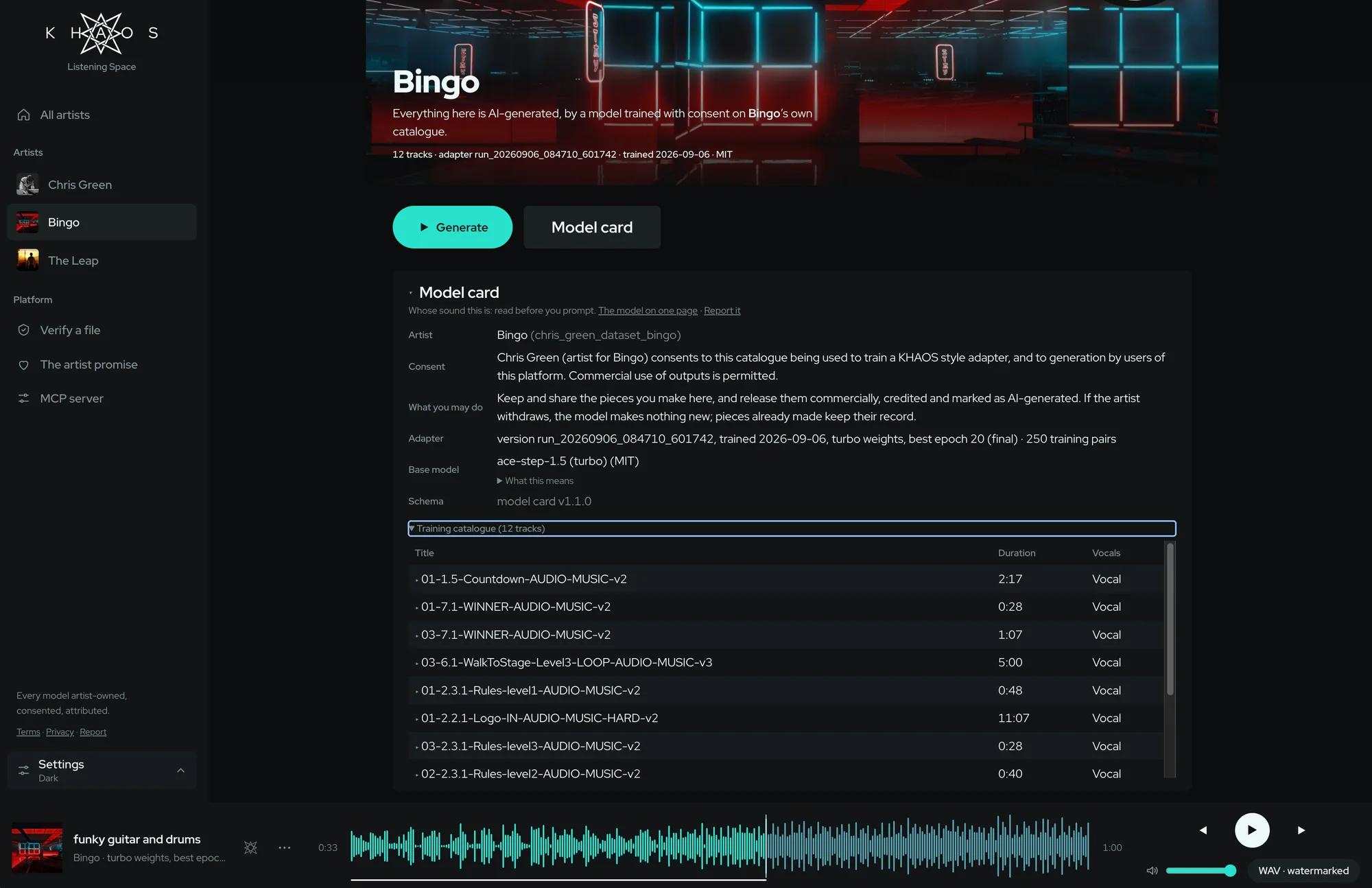
An artist's room in the Listening Space. Its model card, read before anyone asks for anything, gives the consent, what a fan may do and the base model: ace-step-1.5 (turbo).
Recorded
Every output recorded, every share logged
Each output is watermarked, stamped with provenance data and logged with the share each training track contributed. Statements go out each quarter, split by the attribution record.
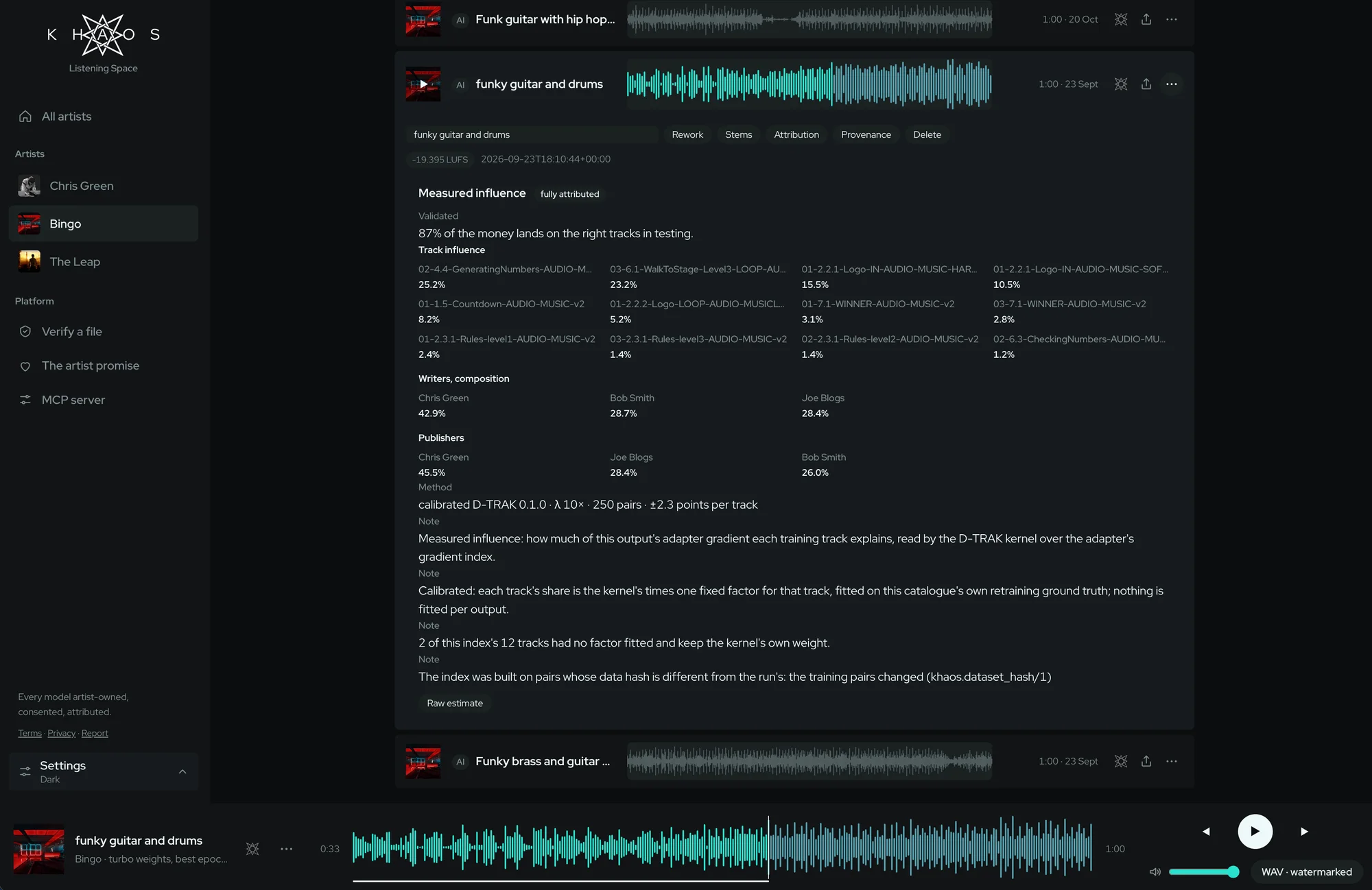
One piece in the Listening Space with its measured influence and splits. Bob Smith and Joe Blogs are test data.
Attribution that survives.
Take a piece of music made by an artist's own model. Strip the metadata, re-encode it as an MP3, and
put it through everything that normally destroys provenance.
The attribution is still there, and it still names the artist.
Under MP3 at 128 kbit/s, a 6 dB level change or a 10% trim, no share moved by more
than 0.05.
Influence
Estimated share of one output attributable to each track in the training catalogue.
PrizesSting72%
WINNER22%
Rules6%
Writers
How the writer share of that output divides, by the attribution record.
Chris Green78%
Bob Smith14%
Joe Smith7%
From the record of one piece, The MOG is in Motion, rounded to the
whole percent; the record gives four places. The training tracks are real; the writer
names and splits are placeholder test data. The full
record, with the audio, the provenance and the signed export, is
on its own page.
The split itself was tested against a retraining ground truth, with the bars set in writing
before any result was scored:
80p in the pound landed on the right tracks, against 70p for a flat split by data share.
87–90p with per-track calibration.
These are estimates with a stated error, and the tests that failed are reported alongside the
ones that passed. The working paper behind these numbers, with the method and the full results,
is published here.
Every piece of audio made with Khaos carries an inaudible watermark and a signed record
saying it is AI-generated. The verifier is free to use, and answers with one of five verdicts.
What each mark survives, its limits, and how to check a file yourself are on
the watermarking page.
The artist owns the model, and Khaos has no claim on it.
No model is sold on, licensed to an AI company, or used to train another.
No prompts for a named artist's style without that artist's consent.
Written into its constitution
Khaos's constitution says that commercial success matters, but as a means rather than an
end.
Khaos takes a fixed fee for work done and a capped share of what a model earns. The cap is
10% in the articles, and
5%, permanently, for the founding cohort. The rest
goes to the people whose work made the model.
Protected from the start.
Rather than waiting until Khaos is successful to ask how its purpose might be protected, Chris
Green wrote that protection into the company from the start.
Khaos is two companies. A non-profit owns the code and holds a guardian share in the company
that does the work, and both companies' articles of association hold the promises above.
Khaos Foundation Limited
A non-profit company limited by guarantee. It owns the Khaos code and the attribution
standard, and holds a guardian share in the operating company with a veto over any sale,
change of purpose, or revision of the fee caps.
Khaos AI Ltd
The operating company. It licenses the toolkit from the Foundation and does the paid
work. Its articles entrench the mission, the fee caps and the consent principles.
The guardian share and the articles are signed and filed at Companies House. The guardians, the
people who will act for the Foundation, are being appointed and will be named on the Foundation's page.
Alongside this sits the Guild of Fine Tuners, which certifies that a model's training data
was the artist's to use, recorded on a public, hash-chained ledger: the
Guild Register.
Khaos Foundation Limited has signed Section 1 of the European Union's Code of Practice on
Transparency of AI-generated Content, as the provider of the Workshop and the Listening Space.
Section 1 is about marking what an AI system makes and letting anyone detect it. The signature went to
the European AI Office on 16 October 2026; it takes effect once the Office assesses the Code adequate.
Khaos is one of 16 high-potential AI companies selected for
Digital Catapult's Applied AI Growth Sprints,
an initiative funded by Innovate UK to help UK deep-tech businesses scale beyond the pilot stage. Its
technical partner is Professor Mick Grierson of the UAL Institute for Creative Computing, and its
rights partner is PRS for Music.
Go deeper
Join the pilot
Get the Workshop from 1 December, free to use. Fans pay to use your
model when the Listening Space opens in 2027.